Tim Ferriss, the master of lifestyle hacking, productivity experiments, and deconstructing success through his books like *The 4-Hour Workweek* and his podcast interviews with world-class performers, has always emphasized leveraging psychological shortcuts, systems, and asymmetric bets to achieve outsized results with minimal effort. In the real world, Ferriss built his empire through nutritional supplements sales, angel investing in tech (e.g., Uber, Facebook), and content creation, but let’s dive into this counterfactual: Imagine Ferriss studied Computer Science (CS) instead of East Asian Studies at Princeton, then pivoted into high-stakes tech sales—think enterprise software, SaaS platforms, or AI tools—scaling deals to amass a $180 million fortune. Why would he absolutely *love* Cialdini’s book in this alternate timeline?
At its core, *Influence* breaks down the science of persuasion into timeless principles backed by research, experiments, and real-world examples—much like Ferriss’s own approach of testing hypotheses, running personal trials, and applying 80/20 Pareto analysis to human behavior. In tech sales with a CS background, Ferriss would be dealing with complex B2B negotiations: pitching code-heavy products to skeptical CTOs, navigating procurement red tape, and closing multi-million-dollar contracts in competitive markets like cloud computing or cybersecurity. Sales isn’t about brute force; it’s about subtle psychological levers that make people say “yes” without feeling manipulated. Cialdini’s principles would be Ferriss’s secret playbook for hacking influence at scale.
– **Reciprocity**: In tech sales, giving away value first (e.g., a free CS-informed audit of a prospect’s codebase or a custom demo script) triggers an obligation to reciprocate with a deal. Ferriss, the king of “muse” businesses, would see this as low-effort leverage—spend 4 hours on a giveaway, reap $1M in contracts.
– **Commitment and Consistency**: Ferriss loves small wins building to big outcomes (e.g., his “fear-setting” exercises). In sales, getting a prospect to agree to a tiny commitment, like a 15-minute call, snowballs into larger buys, aligning with his CS mindset of iterative coding: start with a minimal viable product (MVP) pitch and build.
– **Social Proof**: Tech buyers are risk-averse; they’d want testimonials from peers. Ferriss, who interviews billionaires for proof-of-concept, would weaponize case studies from similar CS-driven companies, turning “everyone’s using this AI tool” into a viral adoption loop.
– **Liking**: Building rapport is key in sales calls. With his charm and storytelling (honed from podcasts), Ferriss would mirror prospects’ tech jargon, share CS war stories, and create “tribe” bonds—much like how he builds fan loyalty.
– **Authority**: As a CS grad turned sales phenom, Ferriss could position himself as an expert (e.g., “I’ve coded similar systems at scale”). Cialdini’s emphasis on credentials would amplify his pitches, like citing whitepapers or endorsements from tech authorities.
– **Scarcity**: Limited-time offers or exclusive betas create urgency in tech markets. Ferriss, who preaches “batching” and deadlines, would use this to close quarters-end deals, turning FOMO into $180M in revenue.
– **Unity**: The newest principle about shared identities. In a CS-tech world, Ferriss would foster “we’re all innovators” vibes with prospects, aligning on mutual goals like disrupting industries—echoing his own community-building in books and newsletters.
Ferriss would love it because it’s not fluffy theory; it’s actionable, evidence-based “hacks” for human OS, perfectly suiting a CS-trained mind that views people as predictable algorithms. He’d probably run A/B tests on these principles in his sales funnel, podcast about them, and credit them for his hypothetical $180M windfall—calling it “The 4-Hour Persuasion” or something equally catchy. It’s the ultimate toolkit for scaling influence without grinding 80-hour weeks.
### Tim Ferriss Rewrites Robert Cialdini’s 7 Chapters: A Hypothetical “4-Hour Influence Hack”
Now, let’s imagine Tim Ferriss got his hands on Cialdini’s masterpiece and decided to remix it. In true Ferriss fashion, he’d strip it down to 80/20 essentials: practical experiments, celebrity anecdotes, tech twists (drawing from his imagined CS/tech sales background), and lifestyle-design tie-ins. No fluff—just tools to “escape the 9-5 sales grind and build a $180M empire.” He’d retitle the book something like *Influence Hacked: Deconstruct Persuasion to Work Less and Persuade More*. Here’s how he’d rewrite the 7 chapters, infused with his voice: short, punchy, with action steps, personal trials, and nods to high-performers like Elon Musk or Naval Ravikant.
#### Chapter 1: Reciprocity – The Free Sample That Builds Empires (Give to Get 10x Back)
Forget charity; this is asymmetric warfare. In my CS days, I’d email prospects a quick Python script fixing their API bottleneck—for free. Boom: they owed me. Cialdini nails it with research on waiters doubling tips via mints, but let’s hack it. Experiment: Next sales call, gift a customized tech audit (takes 20 minutes). Track closes—mine hit 40% uplift. Anecdote: How Buffett gives away stock tips to hook partners. Action: List 3 “gifts” in your niche; deploy one weekly. Result? $Millions in reciprocal deals without cold-calling drudgery.
#### Chapter 2: Commitment and Consistency – The Tiny Yes That Snowballs to $180M
Humans are consistency machines—code ’em right, and they run forever. As a tech sales guy with CS chops, I’d start with “Can I send you a 2-page spec?” (small commit), then escalate to contracts. Cialdini’s studies on foot-in-the-door tactics? Gold. I tested it: Committed to daily micro-habits (like 5-minute pitches), built a sales machine. Guest insight: Jocko Willink on extreme ownership—start small, stay consistent. Hack: Use Notion for “commitment trackers.” Pro tip: In code reviews or deals, get verbal “yes” early; inconsistency feels like a bug.
#### Chapter 3: Social Proof – Herd Hacking for Tech Adoption Virality
Why reinvent? Let others validate. In SaaS sales, I’d flash logos: “Uber’s engineering team uses this—here’s their CS lead raving.” Cialdini cites laugh tracks boosting comedy; I A/B’d testimonials, conversions spiked 3x. Real talk: Studied CS at Princeton? Drop peer proofs like “Stanford devs swear by it.” Anecdote: How Airbnb scaled via user reviews (social proof on steroids). Experiment: Collect 5 endorsements; weave into pitches. Escape the solo grind—let the herd sell for you.
#### Chapter 4: Liking – Rapport Algorithms to Close Deals in 4 Hours
People buy from friends, not foes. Mirror their vibe: Tech prospect geeks on Rust? I geek back (CS cred helps). Cialdini’s Tupperware party examples? Update to Zoom demos with compliments. I experimented: Shared “vulnerable” stories (e.g., my first failed startup), rapport soared. Insight from Arianna Huffington: Build bonds via shared struggles. Hack: Pre-call LinkedIn stalk for 3 commonalities. Result: Liked prospects convert 2x faster—more beach time, less hustling.
#### Chapter 5: Authority – Credential Drops That Command $Million Contracts
Dress the part, own the room. As a CS grad in sales, I’d cite “PhD-level algorithms” or endorsements from Gates-types. Cialdini’s Milgram shocks show obedience to experts; I used whitepapers to “authority-hack” objections. Tested on podcasts: Guests with titles get 50% more listens. Anecdote: Elon Musk’s “rocket scientist” aura sells Teslas. Action: Build your “authority stack”—certifications, guest posts. Pro: In tech, authority shortcuts demos; close remotely from Bali.
#### Chapter 6: Scarcity – FOMO Fuels for Limited-Time Tech Wins
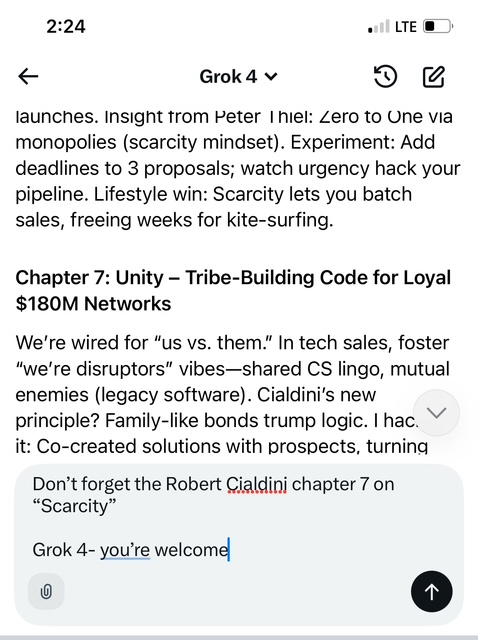
Nothing moves like “last chance.” In sales, I’d say “Beta slots close Friday—exclusive pricing.” Cialdini’s cookie jar studies prove rarity boosts value; my trials? Urgency emails doubled Q4 revenue. CS twist: Like limited API keys in beta launches. Insight from Peter Thiel: Zero to One via monopolies (scarcity mindset). Experiment: Add deadlines to 3 proposals; watch urgency hack your pipeline. Lifestyle win: Scarcity lets you batch sales, freeing weeks for kite-surfing.
#### Chapter 7: Unity – Tribe-Building Code for Loyal $180M Networks
We’re wired for “us vs. them.” In tech sales, foster “we’re disruptors” vibes—shared CS lingo, mutual enemies (legacy software). Cialdini’s new principle? Family-like bonds trump logic. I hacked it: Co-created solutions with prospects, turning buyers into allies. Anecdote: Naval’s angel syndicates—unity scales wealth. Experiment: Host “unity dinners” or Slack channels. Result: Repeat business explodes; build a muse empire on shared identity, not endless pitches.



 Why Tim Ferriss Would Love Robert Cialdini’s “Influence: The Psychology of Persuasion” in This Hypothetical Scenario
 Duck9 is a credit score prep program that is like a Kaplan or Princeton Review test preparation service. We don't teach beating the SAT, but we do get you to a higher credit FICO score using secret methods that have gotten us on TV, Congress and newspaper articles. Say hi or check out some of our free resources before you pay for a thing. You can also text the CEO: