


|
||||||||||||||||||||||||



Chapter 1 to Chapter 14’s an “Easter Egg” at #ch1 to #ch14. Including #ch2 which’s chapter 2 at my house in Napa California
 |
|
|
|
On 09-09-39, “What They Will NEVER Teach You at Stanford Business School” debuts at 300 w 44th St at New York Fashion Week’s front row
http://www.youtube.com/watch?v=QXIaNZi3mHQ
http://www.youtube.com/watch?v=QXIaNZi3mHQ
What A Super Model Can Teach a Harvard MBA About Credit www.slideshare.net/larrychiang/what-a-super-model-can-teach-a-harvard-mba-about-credit
American Express hosts me mentoring you about FICO scores at New York Fashion Week
t.co/inxTmZAj
My video boils down 20,000 hours and moves you to the right on the entrepreneur bell curve
http://www.youtube.com/watch?v=eudADPfTWiE
SWE 277P is part of UC Irvine’s Master of Software Engineering (MSWE) program, a professional-oriented graduate degree focused on practical, AI-integrated software development for working professionals or career changers. It’s the second quarter (4 units) of a two-quarter capstone sequence, following SWE 276P (Capstone Project in Software Engineering I). The course emphasizes applying software engineering principles to real-world projects, often in teams, with an emphasis on design, implementation, testing, deployment, and evaluation of novel software systems. Students integrate concepts from the program, such as AI components (e.g., machine learning models, prompt engineering), system architecture, and agile methodologies. Prerequisites typically include completion of SWE 276P and core MSWE courses like SWE 211 (Software Engineering fundamentals). The project often involves collaboration with external clients or industry partners, culminating in a deployable prototype or full system, preparing students for roles in software development, DevOps, or AI engineering. Enrollment is restricted to MSWE students.
### UCLA Equivalent: CS M177P (Software Engineering Project)
UCLA’s closest equivalent in the Computer Science department (part of the Samueli School of Engineering) is **CS M177P: Software Engineering Project** (4 units, upper-division undergraduate/graduate level, offered as needed, typically Spring quarter). This course is a capstone-style project-based class where students work in teams to design, implement, and deliver a substantial software system for a real client (often from industry or campus organizations). It mirrors SWE 277P’s focus on end-to-end software engineering lifecycle, including requirements gathering, architecture design, coding in modern stacks (e.g., Java, Python, web frameworks), testing (unit/integration), version control (Git), agile practices, and presentation/demo to stakeholders. Like UCI’s capstone, it emphasizes teamwork, documentation, and practical skills for professional software development, with an optional AI/ML integration depending on the project.
– **Key Similarities to SWE 277P**:
– **Project-Driven**: Both are hands-on, client-facing capstones requiring a complete software deliverable, often over one quarter (with UCI’s being a direct sequel to Part I).
– **Skills Covered**: Software design patterns, testing/debugging, deployment, and human factors (e.g., user-centered design), aligning with UCI’s emphasis on AI-powered systems and reliability.
– **Teamwork and Professionalism**: Group-based with peer reviews, client interactions, and oral/written reports—preparing for industry roles.
– **Level and Units**: Graduate-eligible, 4 units; suitable for CS or related majors.
– **Key Differences**:
– **Audience**: CS M177P is primarily undergraduate (seniors in CS, CE, or related fields) but open to graduates; UCI’s is strictly for MSWE master’s students.
– **Depth**: UCI’s includes more explicit AI/ML engineering (e.g., model integration, fine-tuning), while UCLA’s varies by project but can incorporate similar elements via electives.
– **Prerequisites**: For CS M177P, students need CS 111 (Operating Systems) or equivalent, plus senior standing or consent; no direct Part I prerequisite, though prior project courses like CS 130 (Software Engineering lecture) are recommended.
– **Availability**: Offered less frequently at UCLA; check the Schedule of Classes for 2025-2026.
If CS M177P isn’t available or doesn’t fit, consider **CS 188: Projects in Computer Science** (4 units, graduate-level) as a looser alternative—it’s an independent project course allowing self-directed software engineering work, often with faculty mentorship, but less structured than a capstone.
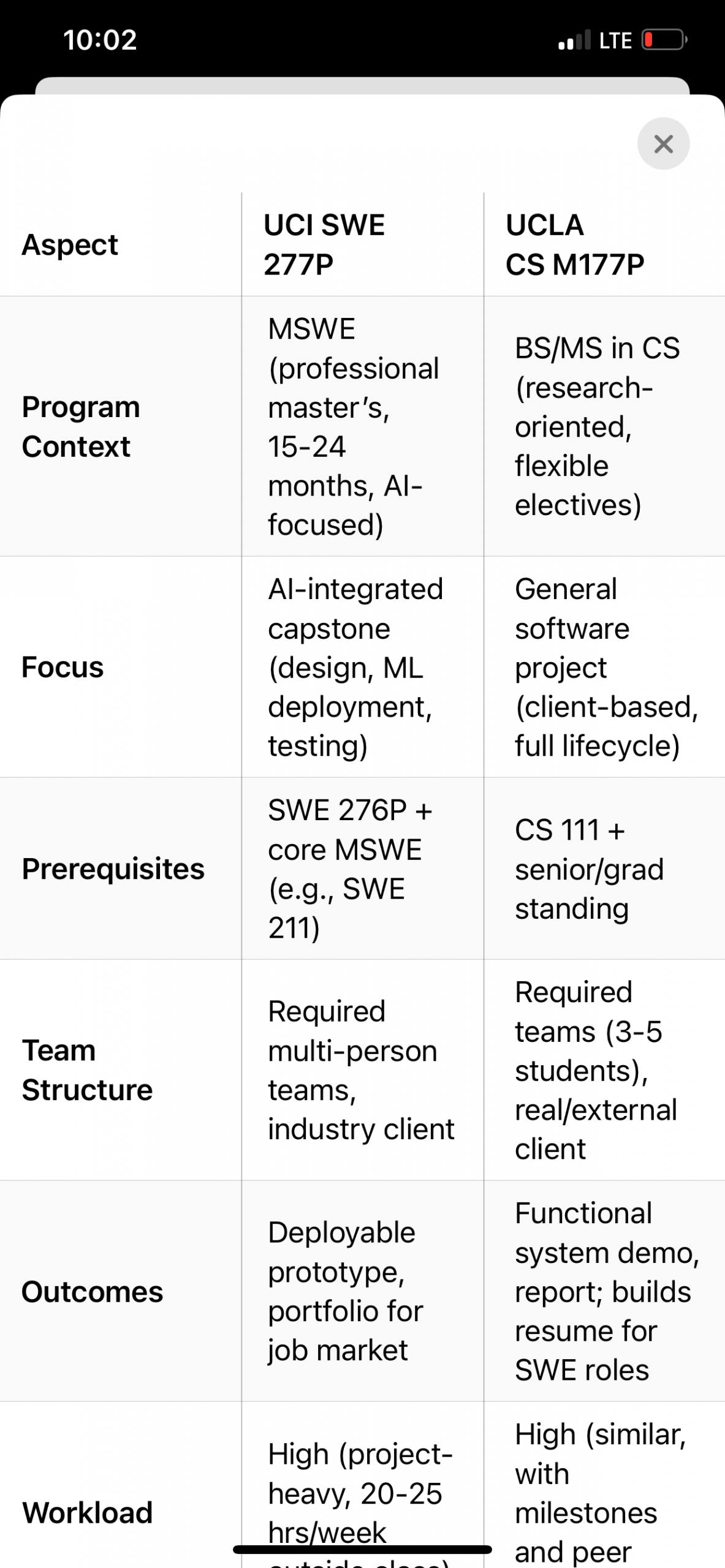

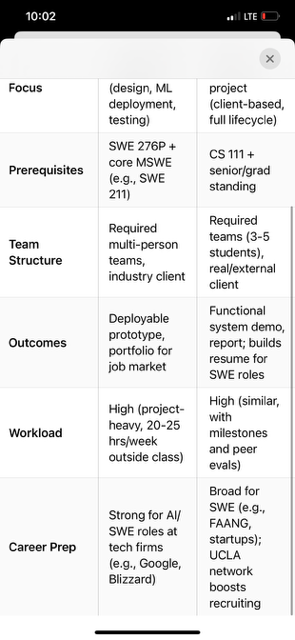


Both courses produce strong portfolios for software engineering jobs, but UCI’s edges out in AI-specific skills, while UCLA’s benefits from its top-ranked CS program and LA tech ecosystem (e.g., easier access to internships at SpaceX, Snap). UCI SWE grads often land roles quickly due to the program’s industry ties, but UCLA CS offers more research flexibility if you’re eyeing grad school.
For the latest syllabi or enrollment, check UCI’s MSWE site or UCLA’s CS department page. If you need transfer credit evaluation, contact UCLA’s Engineering Undergraduate Office. Let me know if this is for transfer/admissions or something else!

 Duck9 is a credit score prep program that is like a Kaplan or Princeton Review test preparation service. We don't teach beating the SAT, but we do get you to a higher credit FICO score using secret methods that have gotten us on TV, Congress and newspaper articles. Say hi or check out some of our free resources before you pay for a thing. You can also text the CEO: