

|
||||||||||||||||||||||||



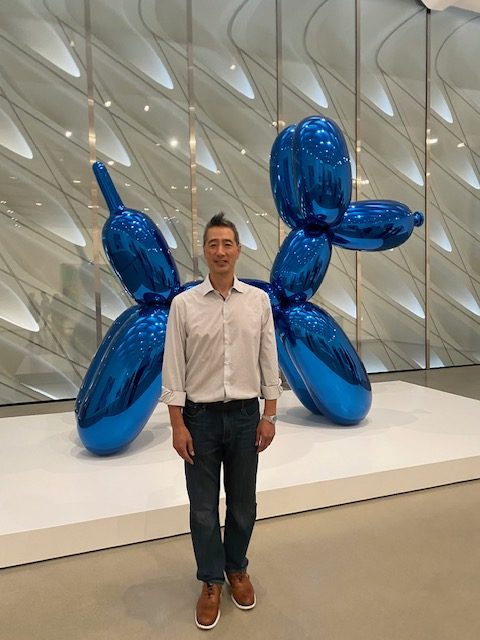
Doing office hours once per year at Irvine Spectrum Mall Dec 6, 2025

### CS 427: Software Engineering I at UIUC – Agenda Overview
CS 427 (Software Engineering I) is a 3- or 4-credit undergraduate course (also cross-listed as CSE 426) offered by the Siebel School of Computing and Data Science at the University of Illinois at Urbana-Champaign (UIUC). It focuses on the fundamentals of software processes, analysis, and design, with a strong emphasis on practical, team-based projects. The course introduces software development paradigms, system engineering, function-based analysis and design, and object-oriented analysis and design. It’s typically offered in the fall semester, with hands-on exercises using real-world team projects to reinforce concepts.
As of September 14, 2025 (early in the Fall 2025 semester), the detailed weekly schedule may vary slightly by instructor (e.g., past sections have been taught by professors like Darko Marinov), but the core topics and structure remain consistent based on the official course description and historical syllabi. The agenda is project-oriented, often incorporating Extreme Programming (XP) practices like user stories, test-driven development, refactoring, and pair programming. Below is a typical topic agenda, drawn from the standard curriculum and past offerings. This is not exhaustive but covers the main modules.
#### Key Learning Objectives
Before diving into topics, note the course’s goals:
– Learn software development processes and paradigms.
– Apply function-based and object-oriented analysis/design.
– Improve common practices like configuration management, testing, and documentation.
– Build skills through team projects (e.g., developing a mid-scale application).
#### Typical Topic Agenda (Semester Structure)
The course spans ~15 weeks, with lectures (2-3 hours/week), discussions, and milestones for a semester-long team project. Topics build progressively from processes to design and implementation. Here’s a standard breakdown:
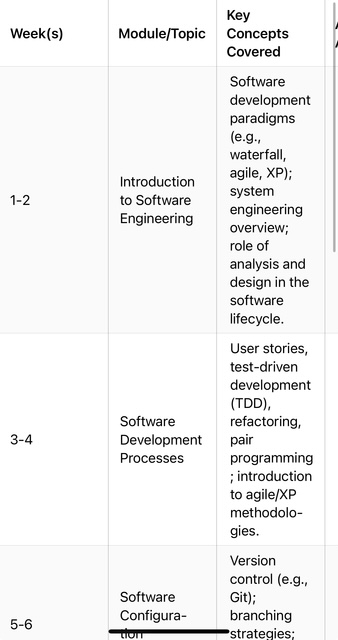
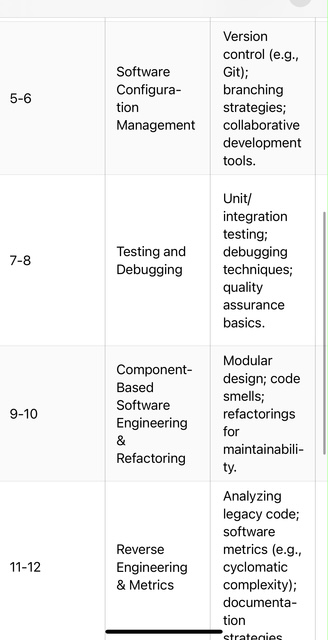
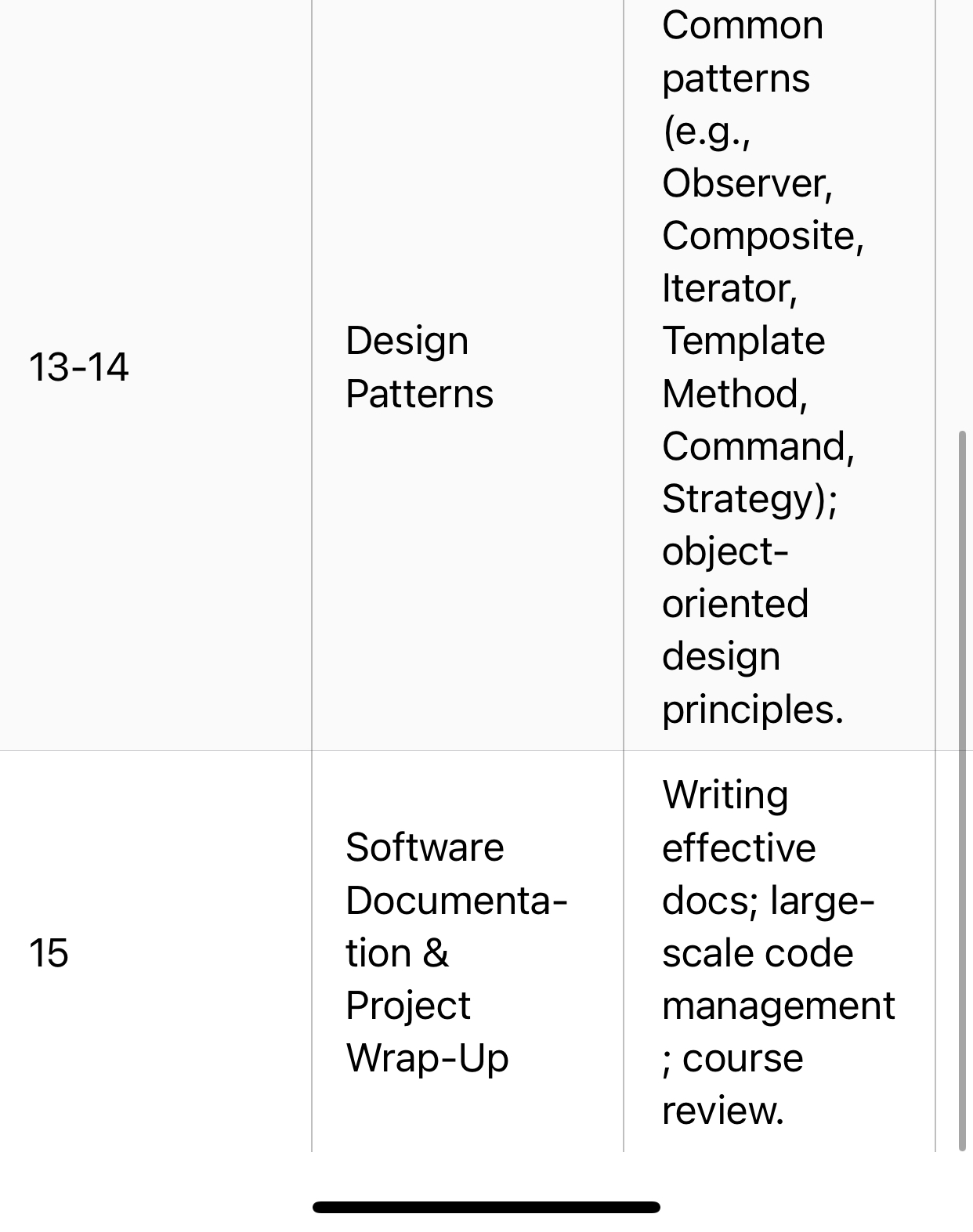
| Week(s) | Module/Topic | Key Concepts Covered | Activities/Assignments |
|———|————–|———————-|————————|
| 1-2 | Introduction to Software Engineering | Software development paradigms (e.g., waterfall, agile, XP); system engineering overview; role of analysis and design in the software lifecycle. | Icebreaker team formation; initial project scoping; introductory readings on processes. |
| 3-4 | Software Development Processes | User stories, test-driven development (TDD), refactoring, pair programming; introduction to agile/XP methodologies. | Hands-on exercises with simple code; start MP1 (e.g., Java basics and build systems like Maven/Ant). |
| 5-6 | Software Configuration Management | Version control (e.g., Git); branching strategies; collaborative development tools. | Project milestone: Set up repository; team-based SCM practice. |
| 7-8 | Testing and Debugging | Unit/integration testing; debugging techniques; quality assurance basics. | MP2: Implement tests for project components; mid-semester project review. |
| 9-10 | Component-Based Software Engineering & Refactoring | Modular design; code smells; refactorings for maintainability. | Apply refactoring to project code; peer reviews. |
| 11-12 | Reverse Engineering & Metrics | Analyzing legacy code; software metrics (e.g., cyclomatic complexity); documentation strategies. | MP3: Reverse-engineer a sample system; metrics analysis on team project. |
| 13-14 | Design Patterns | Common patterns (e.g., Observer, Composite, Iterator, Template Method, Command, Strategy); object-oriented design principles. | Integrate patterns into final project iterations; design documentation. |
| 15 | Software Documentation & Project Wrap-Up | Writing effective docs; large-scale code management; course review. | Final project presentation/demo; exams/quizzes. |
– **Team Project**: A core component (~40% of grade) involves building and iterating on a mid-scale software application (e.g., a web tool or app) in teams of 4-6. Milestones include requirements gathering, design, implementation, testing, and deployment. Tools like UML for modeling and Java/C++ for coding are common.
– **Assessments**: Typically include homework (~20%), exams/quizzes (~20-30%, with trick questions on terminology), project deliverables (~40%), and peer evaluations. For the 4-credit version (often for grads), add a 5-10 page paper on a software engineering book (e.g., from a provided list like “Clean Code”).
– **Prerequisites**: CS 225 (Data Structures) and CS 373 (Programming Paradigms) or equivalents.
– **Resources**: Course notes are free via the class wiki; no required textbook, but readings from sources like “Extreme Programming Explained.” Past sections emphasize breadth over depth, with clear explanations but challenging exams.
For the exact Fall 2025 schedule, including lecture times (e.g., T/Th 2-3:20 PM or similar) and instructor-specific details, check the UIUC Course Explorer or contact the department (e.g., via siebelschool.illinois.edu). Student feedback notes it’s project-heavy but rewarding for building a resume-worthy portfolio, though it can feel elementary if you have prior industry experience. If you’re enrolled, Piazza or the course Canvas site will have the latest syllabus. Let me know if you need reviews or comparisons to similar courses!
 Duck9 is a credit score prep program that is like a Kaplan or Princeton Review test preparation service. We don't teach beating the SAT, but we do get you to a higher credit FICO score using secret methods that have gotten us on TV, Congress and newspaper articles. Say hi or check out some of our free resources before you pay for a thing. You can also text the CEO: