### Bill Gurley’s AI Thesis: Navigating the Industrial Wave
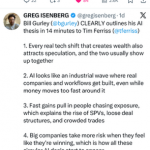
In the 12-19-25 conversation with Tim Ferriss, venture capitalist Bill Gurley distilled his perspective on artificial intelligence into a clear, historically grounded framework. Drawing from Carlota Perez’s seminal work, Technological Revolutions and Financial Capital, Gurley positions AI not as a fleeting speculative frenzy but as an “industrial bubble”—a transformative wave where genuine innovation coexists with financial exuberance, much like the internet boom of the late 1990s.
Carlotta Perez’s model identifies recurring patterns in major technological shifts: every significant revolution attracts speculation alongside real wealth creation. The two forces arrive together, inseparable. Gurley applies this lens to AI, arguing that the current hype—evident in skyrocketing valuations, special purpose vehicles (SPVs), and circular deals among tech giants—does not invalidate the technology’s potential. Instead, it signals a healthy, if overheated, installation phase. Early gains in foundational models have largely been captured by pioneers like OpenAI and Anthropic, but the true enduring value lies ahead: in niche applications that integrate AI into specific industries and workflows.
Consider the dynamics Gurley highlights. Large cloud providers, fearing irrelevance, have engaged in deals that blend investment with revenue recirculation—credits exchanged for services, inflating growth metrics while distorting markets. This echoes past cycles, where easy capital fueled excess before a necessary recalibration. Yet, unlike purely financial bubbles (such as 2008’s housing crisis), industrial ones leave behind durable infrastructure. The dot-com era’s crash did not erase the internet; it paved the way for its widespread deployment.
Gurley’s optimism centers on the shift from broad platform competition to vertical integration. The “biggest AI returns” from early foundational advances are behind us, making broad bets riskier. Opportunities now reside in proprietary data and domain-specific automation—think Zillow leveraging AI for real estate workflows or specialized tools in healthcare and finance. General large language models commoditize rapidly; defensible moats emerge when AI is “stitched” into real-world processes that generic models cannot replicate.
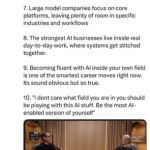
Perhaps Gurley’s most resonant advice is personal rather than institutional: “I don’t care what field you are in—you should be playing with this AI stuff.” In an era where roles across professions face disruption, the best defense is proactive fluency. Become the most AI-enabled version of yourself. Experiment relentlessly, integrate tools into your daily work, and adapt workflows accordingly. This hands-on engagement not only mitigates obsolescence but positions individuals—and companies—at the forefront of the deployment phase, where productivity gains compound into broader economic growth.
As AI matures, Bill Gurley’s thesis reminds us that speculation and substance are dance partners in technological progress. The frenzy may cool, deals may unwind, and valuations may correct. But the underlying wave—mechanizing cognitive tasks, augmenting human capability—promises a golden age if navigated wisely. For investors, builders, and professionals alike, the imperative is clear: focus on real integration over hype, domain depth over generality, and personal experimentation over passive observation. In this industrial revolution, the winners will be those who build enduring systems amid the storm.


– Bill Gurley’s AI thesis, as summarized, frames the technology as an “industrial bubble” like the 1990s internet boom, where speculation coexists with transformative workflow integrations, drawing from Carla Perez’s analysis of historical tech waves.
– He emphasizes that early foundational AI gains are largely captured, shifting opportunities to niche, industry-specific applications with proprietary data, such as automating real estate tasks at Zillow, rather than competing in crowded model development.
– Gurley’s career advice to become “the most AI-enabled version of yourself” resonates widely, with the post’s 95k views highlighting a growing consensus on hands-on AI experimentation as essential for professional adaptability across fields.
| |
| |
 |
 |
|
 |
 |
| The guy who built Claude code admitted that it started as a side project 🤯 |
| |
| 12/27/25, 3:17 PM |
|
|
| |
Chapter
Chapter 1 to Chapter 14’s an “Easter Egg” at #ch1 to #ch14. Including #ch2 which’s chapter 2 at my house in Napa California
http://www.youtube.com/watch?v=ejeIz4EhoJ0
On 09-09-39, “What They Will NEVER Teach You at Stanford Business School” debuts at 300 w 44th St at New York Fashion Week’s front row
http://www.youtube.com/watch?v=QXIaNZi3mHQ
Larry Chiang
Fund of Founders
Founding Stanford EIR
@duck9 alum, Deeply Understood Capital Credit Chinese Knowledge 9
Solo Founder Uber API
650-566-9600 Office
650-566-9696 Direct
Cell: 415-720-8500
650-283-8008 (cell)



 Duck9 is a credit score prep program that is like a Kaplan or Princeton Review test preparation service. We don't teach beating the SAT, but we do get you to a higher credit FICO score using secret methods that have gotten us on TV, Congress and newspaper articles. Say hi or check out some of our free resources before you pay for a thing. You can also text the CEO: