AI’s God Particle
by Larry Chiang on April 14, 2026
 |
|
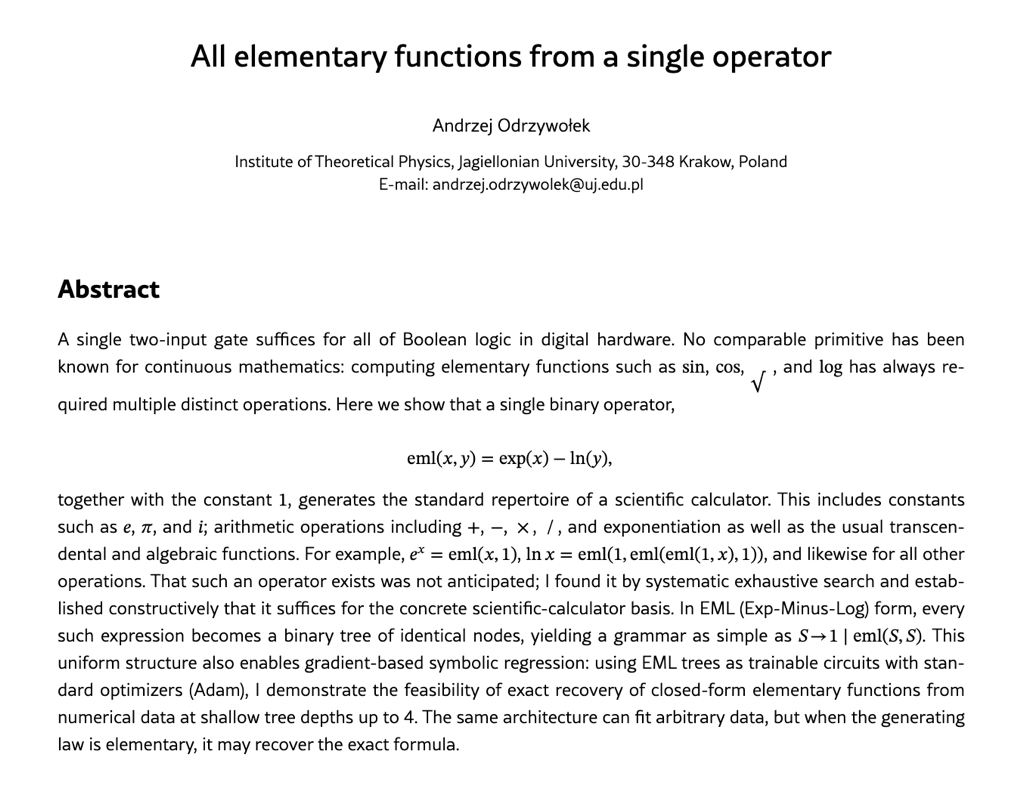
Researchers just proved that every single elementary function, sin, exp, log, sqrt, comes from one single binary operator. It is like finding the “God Particle” for calculus. In computer science, every complex program breaks down to a single logical operator: the NAND gate. It
|
|
|
- A recent arXiv paper by Andrzej Odrzywołek demonstrates that the binary operator eml(x,y) = exp(x) − ln(y), paired with constant 1, generates all elementary functions like sin, cos, log, sqrt, and arithmetic ops through repeated compositions forming identical-node binary trees.
- The uniform EML tree structure enables gradient-based symbolic regression with optimizers like Adam, allowing AI models to recover exact closed-form expressions from numerical data at shallow depths, offering a simpler, regular architecture for scientific machine learning.
- While theoretically elegant and analogous to NAND gates in logic, community responses highlight its impracticality for real computation due to numerical instability from exp/ln and inefficiency compared to specialized functions.




 Duck9 is a credit score prep program that is like a Kaplan or Princeton Review test preparation service. We don't teach beating the SAT, but we do get you to a higher credit FICO score using secret methods that have gotten us on TV, Congress and newspaper articles. Say hi or check out some of our free resources before you pay for a thing. You can also text the CEO: