

 |
||
|

Bankruptcy Language Tonality: Reading the NVIDIA Call When the Numbers Look Fine
The third-quarter fiscal 2027 numbers were exceptional. Revenue hit roughly $116 billion, more than double the prior year. Data-center demand remained strong. Guidance was raised. On paper, the company is executing at a level few in history have matched.
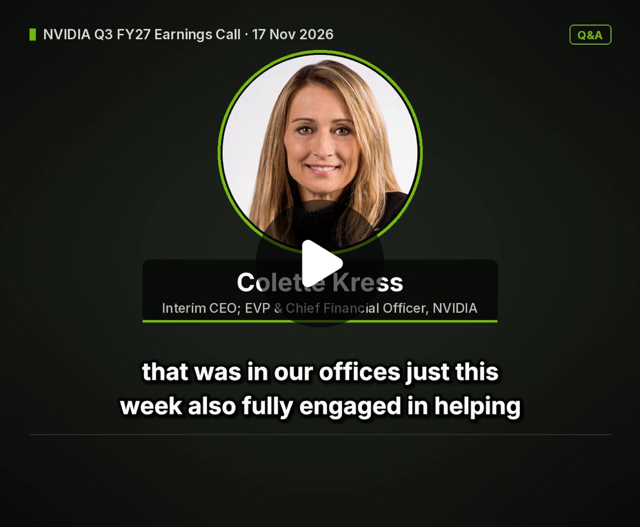
The voices on the call told a different story. Interim CEO and longtime CFO Colette Kress and Board Chair Harvey Jones spoke with the careful, slightly compressed delivery that credit people learn to hear. Suppressed vibrato and low-level tremors do not appear when executives are relaxed and in control. They appear when people are managing pressure they cannot fully acknowledge in public.
This is what bankruptcy language sounds like before the filings start. It is not always the word “liquidity” or “going concern.” More often it is the pattern of over-reassurance, precise legal phrasing around a founder’s exit, and vocal tension that does not match the strength of the reported results.
The signals that matter
When a founder of Jensen Huang’s stature resigns over conduct issues and the board states it does not intend to reinstate him, the company has already accepted a form of key-person discontinuity. Jones’s comments—that the search will consider internal and external candidates, that it will move quickly but not before finding the right person, that the board has retained a search firm—are competent governance language. They are also the language used when continuity is no longer automatic and must be actively asserted.
Kress’s emphasis on “business as usual,” that customers and suppliers are “100 percent behind us,” and that memory and advanced packaging are secured, is the classic counter-narrative. Strong operators do not need to keep repeating that partners remain fully aligned after a sudden founder departure. The repetition itself is the tell. Counterparties begin to reprice risk the moment the person who built the relationships is gone. Receivables lengthen, order patterns become more cautious, and supply agreements that were relationship-based start to require more formal documentation. Those effects show up in the financials later. The voice and the wording show them earlier.
Vocal stress compounds the point. Controlled tremors and reduced natural variation in pitch are physiological responses to sustained cognitive load and risk management. Executives can rehearse the script. They cannot fully eliminate the autonomic signals that appear when the script is defending against an outcome they know is possible.
Pattern recognition from the credit side
Companies rarely go from peak revenue growth to distress in a single quarter. The sequence is more consistent: leadership discontinuity, followed by partner caution, followed by working-capital friction, followed by valuation compression that makes the original capital structure look heavy. Sales can still rise while the quality of those sales and the durability of the relationships quietly change. When sales double, receivables often rise faster; the gap is where the stress lives.
NVIDIA’s current results do not show that gap yet. The transition introduces the conditions under which the gap can open. Governance changes of this type are not abstract. They alter decision speed, customer confidence, and the willingness of suppliers to extend the same informal flexibility the founder once enjoyed. Markets eventually price the difference.
The case-study takeaway
The earnings call is a clean illustration of bankruptcy language tonality in a company that is not in bankruptcy and may never file. The numbers establish operational strength. The language and the voices establish transition risk. Credit analysis has always paid more attention to the second set of signals once the first set is no longer in doubt. The gap between the two is where the actual story lives.
Larry Chiang prediction: Jensen Huang will buy his company back for nickels on the dollar.

 Duck9 is a credit score prep program that is like a Kaplan or Princeton Review test preparation service. We don't teach beating the SAT, but we do get you to a higher credit FICO score using secret methods that have gotten us on TV, Congress and newspaper articles. Say hi or check out some of our free resources before you pay for a thing. You can also text the CEO: