

“A Princeton historian said his students arrive on campus with a narrower vocabulary and less understanding of language than they used to have. There are always students who “read insightfully and easily and write beautifully,” he said, “but they are now more exceptions.”
Jack Chen, a Chinese-literature professor at the University of Virginia, finds his students “shutting down” when confronted with ideas they don’t understand; they’re less able to persist through a challenging text than they used to be.
Daniel Shore, the chair of Georgetown’s English department, told me that his students have trouble staying focused on even a sonnet.
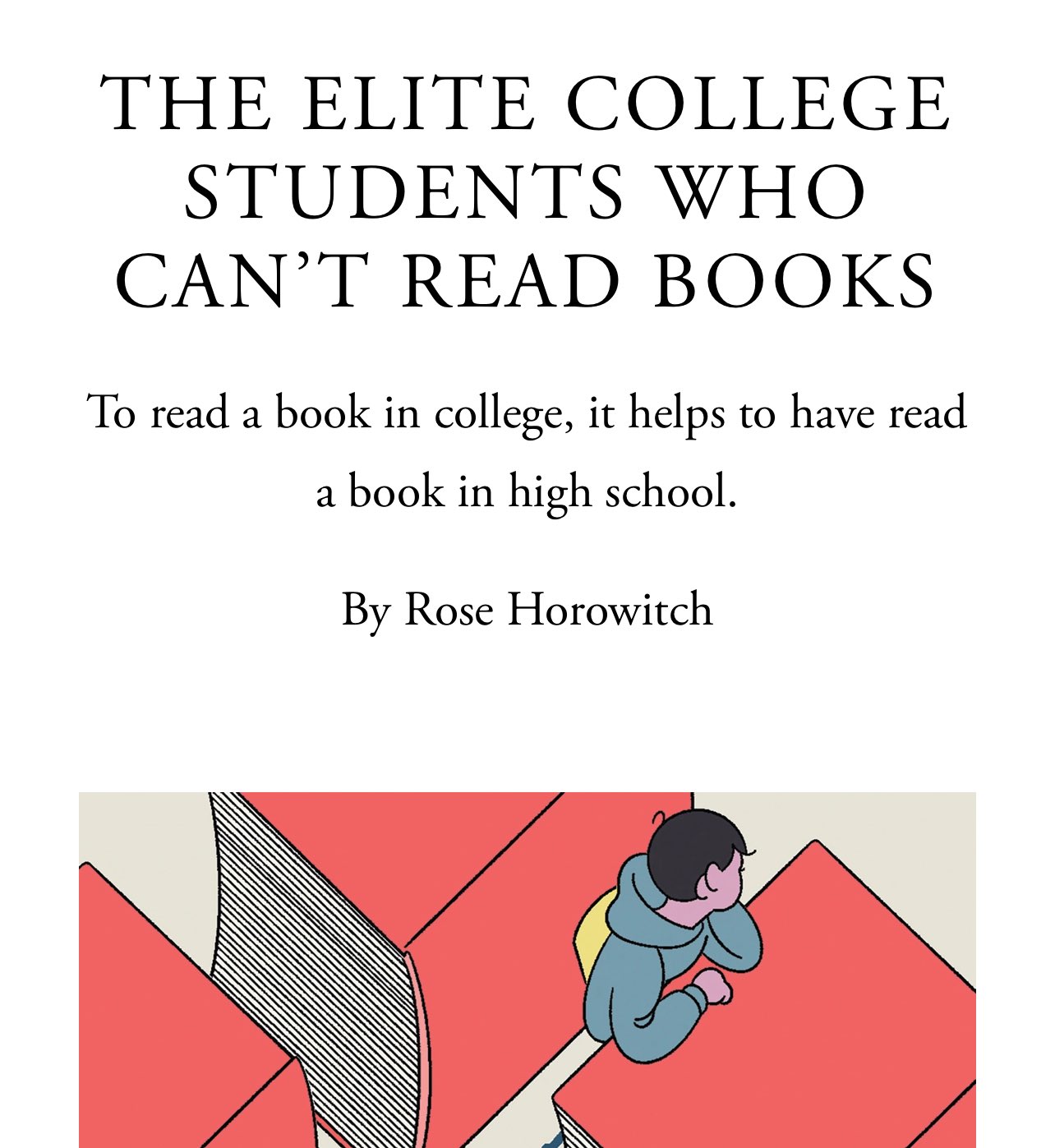
In case you missed it, Rose Horowitch’s grim coverage of the declining reading skills of American college students went viral
The role of education policy in these shifts gets attention; @DKThomp asked her about it in his podcast, too. It’s fair to point to No Child Left Behind and the pressures of standardized testing as a culprit.
The Common Core, on the other hand, is an unlikely culprit: nothing about introducing more nonfiction into classrooms – which primarily affected elementary grade curriculum – necessitates a move away from books and towards passages. In classrooms using the most Common Core-aligned curricula, you’ll find elementary students reading books about pollinators and sea mammals, and whole texts through HS.
Accordingly, Sue Pimentel, the lead author of the CCSS in ELA, has been the loudest advocate for placing texts at the heart of instruction.
I’d say the shift is probably as much culture as policy: schools are simply lowering the rigor bar, and few are challenging this shift. Or frankly, paying much attention to it.
Also, the shifts in book-centered curriculum are a supply-side story, as much as a demand-side story. It’s more profitable to sell a curriculum full of passages than it is to sell one full of books.
This supply-side story deserves more exploration.
|
||||||||||||||||||||||||








 Duck9 is a credit score prep program that is like a Kaplan or Princeton Review test preparation service. We don't teach beating the SAT, but we do get you to a higher credit FICO score using secret methods that have gotten us on TV, Congress and newspaper articles. Say hi or check out some of our free resources before you pay for a thing. You can also text the CEO: