


Bitcoin isn’t real! It’s not physical!
Yeah? Neither is the number seven, but I bet you’d notice if your bank balance dropped by seven figures.
Let me break the spell for you: money has never been “real.”
Money is a collective hallucination—a social construct we all agree to pretend exists so we don’t have to barter chickens for dental work.
Gold wasn’t money because it fell from heaven with “LEGAL TENDER” stamped on it.
We picked gold because it was the least-bad physical object that checked the boxes:
– Scarce
– Durable
– Divisible
– Portable
– Verifiable
It was the analog solution to our shared idea.
But here’s the thing about analog: it’s slow, heavy, and requires armed guards.
And here’s the thing about humans: we engineer better tools.
We went from abacus to iPhone. From carrier pigeons to satellites.
From gold bars locked in vaults to Bitcoin—verified by thermodynamics, secured by energy, and transmitted at the speed of light.
Bitcoin is the digital versioin of money. Just like X is the digital version of town hall.
Gold was the best we could do for many centuries.
Bitcoin is what we can do now that we have cryptography, distributed consensus, and proof-of-work anchored in physics.
Your grandpa trusted gold because he could hold it.
You trust Bitcoin because you can verify it.
One required faith in a metal. The other requires faith in math.
Guess which one has never been debased, diluted, or confiscated by executive order?
The concept of money is a human mental construct.
Always has been. Always will be.
The only question is: do you want your construct built on scarcity enforced by governments—or scarcity enforced by code?
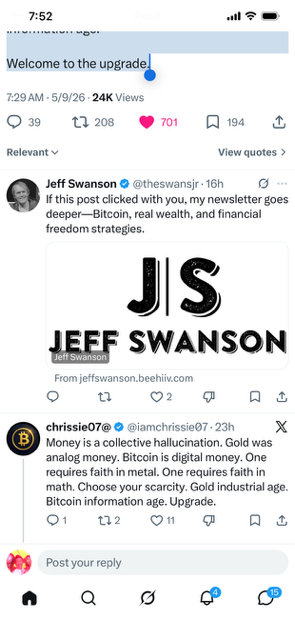
Gold was monetary technology for the industrial age. Bitcoin is monetary technology for the information age.
Welcome to the upgrade.
 Duck9 is a credit score prep program that is like a Kaplan or Princeton Review test preparation service. We don't teach beating the SAT, but we do get you to a higher credit FICO score using secret methods that have gotten us on TV, Congress and newspaper articles. Say hi or check out some of our free resources before you pay for a thing. You can also text the CEO: