

 |
||
|

Why Smart People “Fail”: Closing the Habit Gap with Tiny Changes, Miraculous Mornings, and Practical Discipline
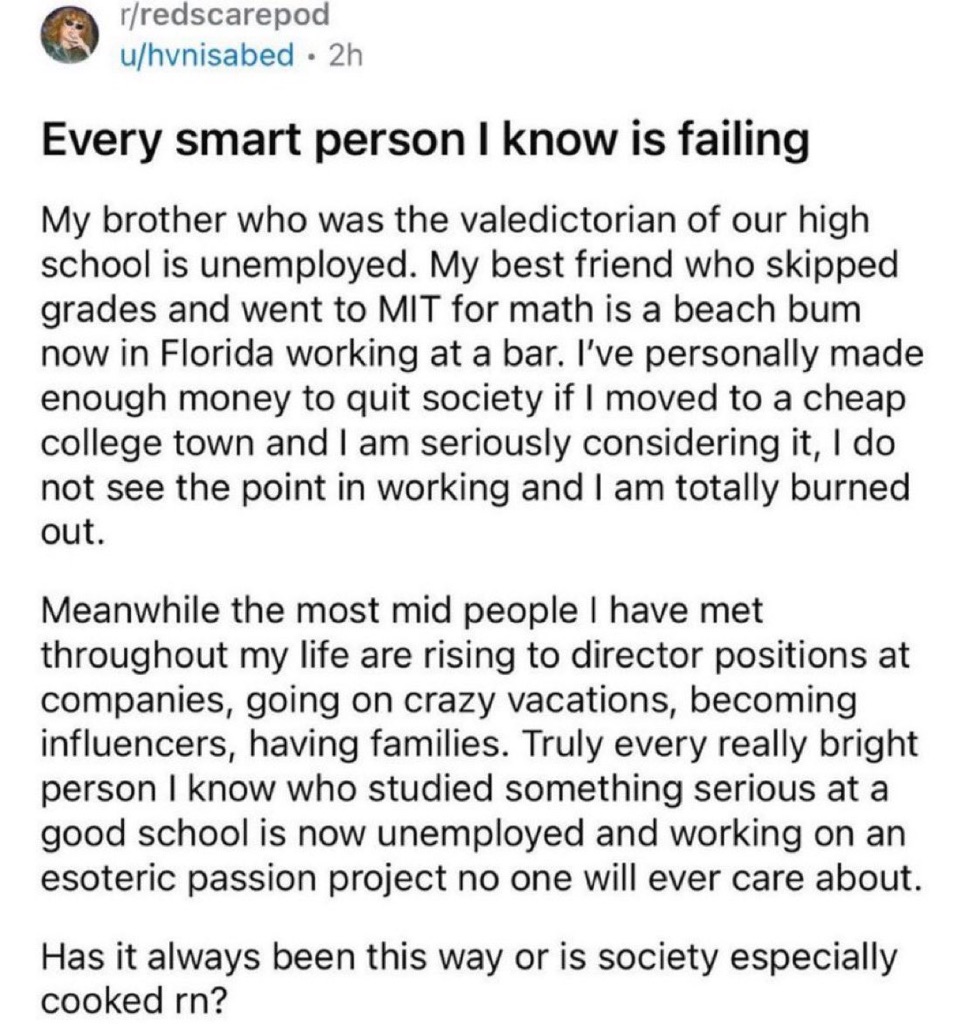
The observation feels familiar: exceptionally intelligent, high-achieving people often struggle while more “average” or “mid” individuals climb to director roles, build families, take great vacations, and appear to thrive. A Reddit post in r/redscarepod captured this perfectly: the high school valedictorian is unemployed; the friend who skipped grades and attended MIT for math is now a beach bum bartender in Florida; the poster themselves feels burned out despite financial options to opt out; meanwhile, everyday peers advance through consistent execution. Every truly bright person studied something serious at a good school and ended up unemployed or lost in esoteric passion projects. The question: Has it always been this way, or is society “especially cooked rn”?
X user Larry Chiang (@LarryChiang) quoted the post with the wry caption “A tale ass old ass time” — a slangy nod to the timeless nature of the pattern. Intelligence alone doesn’t guarantee outcomes. The differentiator often lies in habits — the invisible systems of daily behavior that compound over time. “Mid” people frequently win through consistent action, self-promotion, networking, and bias toward execution, while high-IQ individuals may overthink, burn out, pursue perfection, or default to passive or scattered efforts.

This essay expands on that Reddit insight by weaving in practical wisdom from BJ Fogg (Tiny Habits), Hal Elrod (The Miracle Morning), and Larry Chiang’s real-world X posts on breaking negative patterns and building sustainable routines. The core thesis: Smart people don’t inherently fail; many simply lack (or haven’t built) the habit architectures that turn potential into consistent results.
The Habit Gap: Intelligence vs. Execution
High intelligence correlates with better average life outcomes statistically, but anecdotes and observations reveal a gap. Smart individuals often excel in structured academic environments where rules are clear and feedback is immediate. In the messy real world, success rewards bias to action, resilience through repeated small efforts, likability/networking, and the ability to sell oneself or one’s ideas.
Commenters on the Reddit thread noted traits like “extreme bias to action” in successful peers — people who follow through on ideas without overanalyzing risk/reward endlessly. Smart
http://www.youtube.com/watch?v=ejeIz4EhoJ0
http://www.youtube.com/watch?v=QXIaNZi3mHQ
What A Super Model Can Teach a Harvard MBA About Credit www.slideshare.net/larrychiang/what-a-super-model-can-teach-a-harvard-mba-about-credit
American Express hosts me mentoring you about FICO scores at New York Fashion Week
t.co/inxTmZAj
My video boils down 20,000 hours and moves you to the right on the entrepreneur bell curve
http://www.youtube.com/watch?v=eudADPfTWiE
whattheydontteachyouatstanfordbusinessschool.com/blog
CNN Video Channel: ireport.cnn.com/people/larrychiang
Read my last 10 X posts at www.X.com/LarryChiang
Author of #WTDTYASBS a NY Times Bestseller released 09-09-09 at #NYFW on a runway under the tents
whattheydontteachyouatstanfordbusinessschool.com/blog/?s=Ny+times+bestseller
www.fastcompany.com/embed/c0d4562ea2049
52 Cards. Two Jokers. What They DO Teach You at Stanford Engineering
http://www.youtube.com/watch?v=vDBY0GkI3-g
Emergency swings and cutting deals as an 9 year old
http://www.youtube.com/watch?v=OFGY7v9C4G0
Hunter Pence shared thoughts before winning WORLD SERIES’ Game #7
http://www.youtube.com/watch?v=usu0luYy9pw
 Duck9 is a credit score prep program that is like a Kaplan or Princeton Review test preparation service. We don't teach beating the SAT, but we do get you to a higher credit FICO score using secret methods that have gotten us on TV, Congress and newspaper articles. Say hi or check out some of our free resources before you pay for a thing. You can also text the CEO: