


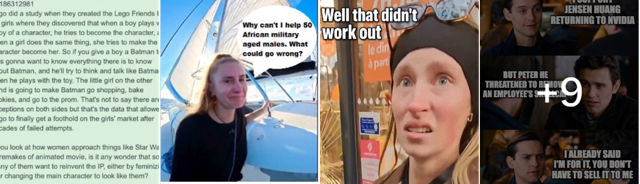
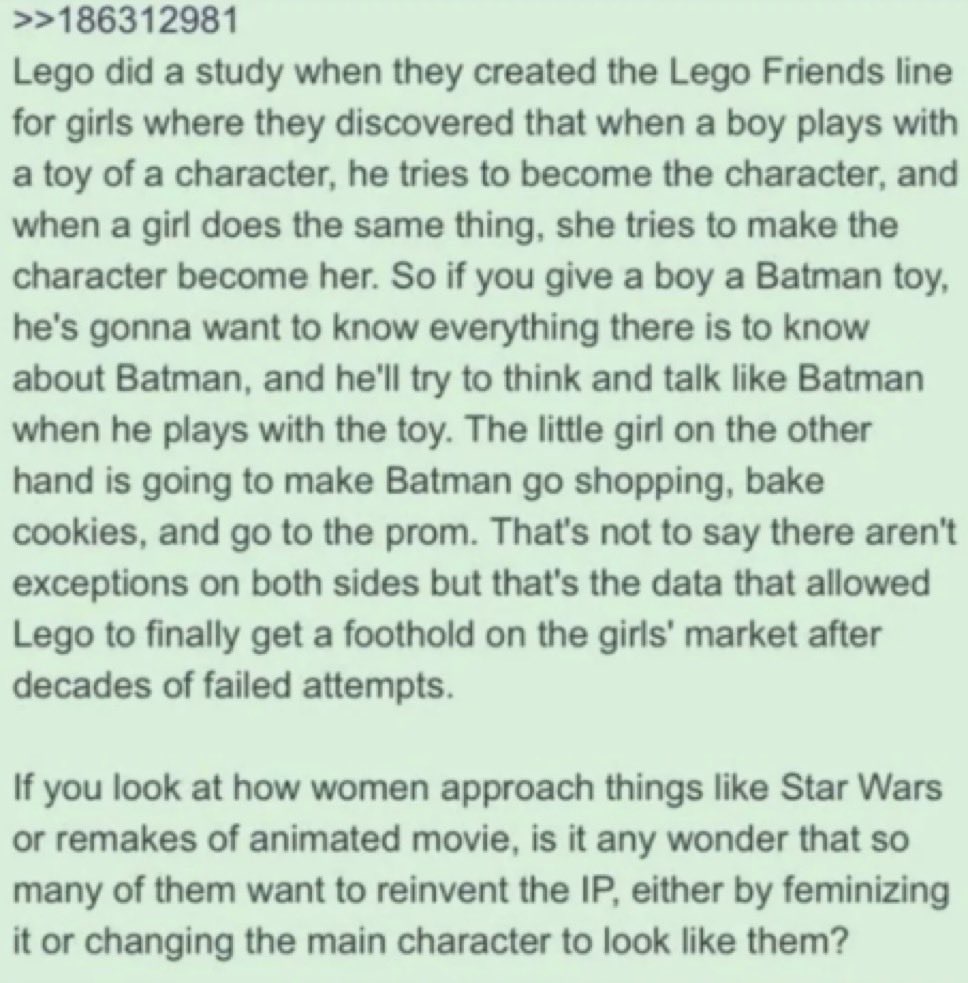
In the years leading up to the 2012 launch of Lego Friends, the company conducted multi-year ethnographic and market research involving thousands of girls and their mothers across multiple countries. At the time, roughly 90% of Lego sets were purchased for or used by boys, leaving a large potential market underserved. Researchers observed consistent differences in how children interacted with the same construction toys.
Boys typically focused on exterior, action-oriented, and fantasy or good-versus-evil scenarios. They tended to treat figures as third-person actors (embodying roles such as warriors or explorers), prioritized rapid completion of complex structures, and often used finished models for display or combat-style play. Girls more frequently emphasized interior spaces, relational storytelling, and everyday life details. They projected themselves more directly onto figures (treating them as avatars), preferred smaller incremental builds that allowed role-play along the way, and valued realism, social interaction, and personal identification with characters over pure exterior spectacle or abstract fantasy.
These observations informed the design of Lego Friends: more realistic mini-doll figures with detailed features that facilitated self-identification, story-driven sets centered on friendship, hobbies, and community settings rather than primarily combat or heroic arcs, and elements that supported ongoing narrative play. Designers noted that girls often wanted figures they could relate to as extensions of themselves, whereas boys more readily adopted external character roles. Subsequent company research (such as the 2021 “Ready for Girls” work with the Geena Davis Institute and the 2024 “Play Unstoppable” study) has shifted emphasis toward societal language bias, perfectionism pressures that erode girls’ creative confidence over time, and calls for broader inclusivity, while the earlier Friends-era research remains the primary source of the observed play-pattern distinctions.
Remixed into Female Entrepreneurship Advocacy and Catalysts (Larry Chiang style)
Women do not play with existing systems the way men do. They do not default to “become the character and defend the lore.” They make the character become them. That is not a bug in intellectual property or franchises. It is the core operating system of female entrepreneurship.
The same pattern that showed up in Lego research is a catalyst set:
• Self-projection as customer empathy. Boys treat the figure as third-person. Girls insert themselves. In markets, that becomes superior detection of real user pain, social context, and relational friction that pure “build the castle and fight the dragon” product thinking misses. Catalyst: design products and services that start from lived identity rather than abstract hero narratives. This is why women-led consumer, health, education, and community platforms often achieve faster product-market fit in relationship-dense categories.
• Interior and relational focus over exterior spectacle. Research showed girls looked inside the castle and asked what was missing; boys grabbed the catapults. Entrepreneurship translation: women systematically map the internal workflows, trust networks, care obligations, and status dynamics that make a deal or product actually work in daily life. Catalyst: build around those interiors (community platforms, fintech that handles household cash flow, tools that reduce relational load). Capital and distribution follow once the interior is solved.
• Incremental narrative builds instead of single massive structures. Boys finished the big model. Girls stopped for role-play and rearranged. In business, this maps to faster iteration cycles, smaller viable offerings that generate immediate social proof, and continuous storytelling that compounds loyalty. Catalyst: ship the café, the vet clinic, the salon equivalent first; let the narrative run; expand. Avoid the two-hour solitary assembly model that produces beautiful but unused castles.
• Avatar realism as market entry. Girls rejected blocky minifigures they could not see themselves in. Women founders reject pure fantasy pitches and demand products that reflect actual constraints (time, caregiving, social capital, aesthetic and identity signals). Catalyst: fund and scale the realistic mini-doll versions of markets—ones that look like the buyer, not the idealized warrior. The data already showed this unlocked a previously ignored segment for Lego; the same logic unlocks previously ignored customer segments for startups.
Men understand the exterior game: scale the structure, defend the lore, become the role. Women systematically rewrite the interior so the system serves the person using it. That rewrite is the catalyst. Stop treating it as contamination of existing IPs or existing industries. Treat it as the deliberate, high-ROI strategy for owning the next layer of consumer, relational, and identity-driven markets. The research is old. The commercial implication is current.
 |
||
|







 Duck9 is a credit score prep program that is like a Kaplan or Princeton Review test preparation service. We don't teach beating the SAT, but we do get you to a higher credit FICO score using secret methods that have gotten us on TV, Congress and newspaper articles. Say hi or check out some of our free resources before you pay for a thing. You can also text the CEO: