The Missing Link in Startup Education: Embracing Distribution Through CS183D
In the sunshined brownstone buildings of Stanford University, the CS-183 series has become a fulcrum of entrepreneurial education. Peter Thiel’s original CS183: Startup (2012) dissected the philosophical underpinnings of building companies from zero to one. Sam Altman’s CS183B: How to Start a Startup (2014) provided practical blueprints for ideation, team-building, and early traction. Reid Hoffman’s CS183C: Blitzscaling (2015) focused on hyper-growth strategies for scaling once product-market fit is achieved. Yet, conspicuously absent is CS183D—a course that would bridge the gap between ideation and scaling by emphasizing *distribution*: the art of talking to customers and prospects to identify and solve real problems. Why was “D” skipped? The answer lies in the blind spots of the preceding courses. CS183B and CS183C, led by Altman and Hoffman, prioritized internal mechanics like product development, fundraising, and rapid expansion, but they fell short on the gritty, interpersonal work of engaging directly with users to uncover pains and iterate solutions. Without this focus, startups risk building in a vacuum, creating products nobody truly wants or knows how to sell.
Enter Larry Chiang’s #cs183d—a grassroots, practitioner-driven curriculum that fills this void, drawing from decades of real-world sales engineering and distribution hacks. In this essay, we’ll weave Chiang’s #cs183d with timeless Y Combinator (YC) advice and the origin story of Zapier via Andrew Warner’s Mixergy experience, illustrating how distribution isn’t just a tactic—it’s the lifeblood of startup success.
## The Core of #CS183D: Distribution as the Ultimate Problem-Solver
Larry Chiang, a Stanford engineering alum and self-proclaimed “vaginaWhisperer” in his bio (a quirky nod to his unfiltered, direct style), has long championed #cs183d as the “D” for Distribution—the missing Stanford class that teaches engineers how to sell, arbitrage, and connect with customers. Drawing from his blog “What They Don’t Teach You at Stanford Business School” and a plethora of YouTube videos, Chiang argues that distribution is about practicing on real “cadavers” (failed ideas or zombie entities) before going live. In one LinkedIn post, he describes memorizing Stanford lectures using memory techniques from *Moonwalking with Einstein*, but applies it to sales: “The trick I used to ace classes was pre-studying at home. You can’t just show up for #cs106a or #ENGR145—study the video first.” Translate that to startups: Don’t build blindly; talk to prospects first to validate pains.
At its heart, #cs183d is 70% cold opens, tech sales, and lead generation (#LeadGen), with a dash of arithmetic and external APIs for leverage. Chiang’s YouTube playlist “CS 183 Series; Larry Chiang’s Video Study for Entrepreneurs” breaks it down into micro-lessons. For instance, in “CS 183e, Lec 10 Video 4 of 12 #cs183e” (a fork from #ENGR145), he emphasizes “practicing distribution” as semi-entrepreneurial exercises: “Sell me this pen, sell me these Stanford shorts (XXL).” It’s a nod to *Wolf of Wall Street*, but grounded in engineering: Use APIs to arbitrage deals, like connecting Nobu reservations (#externalAPI) for profit. Chiang’s posts on X (formerly Twitter) hammer this home—over 63,000 tweets on #cs183d since 2019. In a recent thread (Dec 2025), he quips: “Tech Sales is #cs183d. YC is gif 1 (founders), me and Jeremy Lin draining 3’s at safety schools = gif 3.” Here, he contrasts YC’s founder-focused mantras with real distribution: Knocking on doors, like missionaries or car salesmen, to close deals.
Why does this matter? Because, as Chiang notes in his Duck9 blog, “22 Positive Contributions Larry Chiang Made at Stanford,” most engineers graduate with “Zero 2 national account manager” skills—great at coding, terrible at B2B sales (#CS183D #ENGR145). He calls it “Eager Novices Gain” (ENG), where novices arbitrage open-source deals to make money. Involuntary Money Celibate (“ey Moo Cell”) is his term for those who’ve never flipped a profit—avoid it by cold-opening prospects. Videos like “Practicing. Video 6 of 6; Lec 9, #cs183e” stress: “The practice of distribution is meant for you to practice being semi-entrepreneurial.” Examples abound: Sell sperm (#cs183d), sell festival tickets via affiliates (#aclFest), or even “Sell me one bitcoin” in a Texas Institute of Technology Sales exercise. Chiang’s philosophy: Distribution > Product in a gold rush era where everyone builds the same AI tools.
Chiang forks #cs183d into variants like #cs183e (Edit/Entrepreneurial Use of Bankruptcy Models, or EUBM), #cs183s (perhaps “sales” or “society”), and even #cs183bullpen (preparing pitches). In a 2024 LinkedIn post: “#cs183a34z #cs183d—Pansexual Neurodivergent steps into my world… Do you even QB at Stanford Sam Altman?” It’s a jab at Altman’s CS183B for skipping sales drills. Chiang’s “Double Asian” turnaround expertise (#cs183e) involves “donkey punching” failing ventures with value-add middleman plays (#cs183eubm). Posts from 2025 show him tying distribution to real events: Congratulating apps like Buy’r (#cs183d), analyzing tZERO’s slow launch, or using food for #LeadGen at Tesla diners. He even critiques Grok’s hallucinations on #cs183d, urging audits (#cs183audit) to champion details.
This 70% focus on #cs183d underscores why Stanford skipped “D”: CS183B and CS183C assumed customer insights magically appear post-ideation. Altman emphasized “Startups = Growth,” but without cold calls, growth stalls. Hoffman’s blitzscaling ramps users, but ignores prospecting pains. Chiang fills this by teaching “ch6” (Chapter 6: Cold Open Yahtzee), “ch7” (1-year cliffs), and “externalAPI” for arithmetic wins. In his words: “Stanford has a East Palo sized donut hole called ‘cs183-d’… But skipped ‘D, distribution’.” His content is raw—hashtags like #hiLarryAss, #vaginaWhisperer—but effective: Practice on cadavers, use APIs, sell virally on LinkedIn videos.
## Integrating YC Wisdom: Talking to Users as Distribution’s Foundation
Y Combinator’s advice aligns seamlessly with #cs183d’s customer-centric ethos, though YC leans more on iteration than pure sales. Core mantras like “Make something people want” and “Talk to users constantly” echo Chiang’s cold opens: Do unscalable things like manual onboarding or phone calls to uncover pains. YC urges: “Launch fast and iterate,” but #cs183d adds the distribution twist—sell the MVP via arbitrage before perfection. “Focus” and “Growth is the only thing that matters after PMF” dovetail with Chiang’s “Sell something that sells itself,” but he warns: YC treats marketing and sales interchangeably, missing nuanced prospecting.
YC’s “Solve a problem you personally have” boosts founder-problem fit, which Chiang extends to “Founder-market fit” via tech sales drills. Hiring? YC says “Hire slowly, fire fast”; #cs183d applies it to sales teams: Recruit for attitude (maniacal work ethic) since skills teachable. Fundraising? “Default alive” and “Raise when you have traction” pair with Chiang’s #LeadGen for bootstrap revenue. YC one-liners like “If you’re not embarrassed by v1, you launched too late” resonate with #cs183d’s “delete, delete, delete” (borrowing from Musk, whom Chiang cites in threads). Yet, YC’s “Write code or talk to users—everything else is bullshit early on” is amplified in #cs183d: Talking *is* distribution, not optional.
Andrew Warner’s Zapier Story: A #CS183D Case Study in Action
The Zapier origin, shared by Andrew Warner on Mixergy, exemplifies #cs183d’s principles blended with YC wisdom. In 2011, Warner needed to automate PayPal exports to his CRM for podcasts—a real pain. Zapier co-founder Wade Foster cold-emailed a no-code prototype (Snapier). Despite MVP confusion (needing internal IDs), it solved Warner’s issue so acutely he wired payment to Foster’s personal PayPal, fueling development. This mirrors YC’s “Make something people want” and “Talk to users,” but it’s pure #cs183d: Cold open prospects, identify pains, distribute via prototypes. Warner’s 2,000+ founder interviews reinforce: Relieve big pains for outsized success. Zapier’s multi-billion valuation? Built on distribution—talking to early users like Warner, iterating on feedback. Chiang would call it “arbitraging open-source deals”: Use APIs (#externalAPI) to connect pains, sell immediately.
Conclusion: Distribution Tilts the Odds
Stanford’s omission of CS183D stemmed from CS183B and CS183C’s oversight: They lacked emphasis on talking to customers and prospects to solve problems, focusing instead on internal growth engines. Larry Chiang’s #cs183d rectifies this, teaching distribution as the bridge—cold opens, tech sales, #LeadGen—that turns engineers into revenue machines. Blended with YC’s user-obsession and stories like Zapier’s, it forms a complete playbook: Build for pains, distribute relentlessly, grow exponentially. As Chiang tweets: “Distribution is more important than product… the only way to win is better distribution.” Ruthlessly apply this for 2-3 years, and the odds tilt dramatically in your favor.
I was Zapier’s first customer. How they sold me should be taught in every business school.
2011, I had the first paid subscription podcast and I wanted to send handwritten thank-you notes to buyers. But getting their addresses out of PayPal was a pain in the butt.
So I went to the StackExchange message board and posted: How can I get PayPal addresses into my CRM?
Months went by with no solution. Nobody knew how to do it.
Then I get an email from a guy named Wade.
“Would you be interested in a service that lets you do this without writing a single line of code?”
My reaction: HELL YEAH.
We jump on a call.
He and his friends were building something (called Snapier at the time) that could connect apps.
We screenshare. And I see the most confusing MVP ever.
One example: I had to know my CRM’s internal id numbers. WTF is that?
But I still loved it. As confusing as it was to use, it solved a painful problem.
I was so desperate to keep this software that I wanted to do whatever I could to ensure Wade and his team kept building it.
So I insisted on paying. I demanded a way to send him money.
Turns out Snapier (later named Zapier) didn’t have a way to collect payments. It didn’t even have a bank account. I sent money to Wade’s personal PayPal.
Today Zapier is a multi-billion-dollar AI automation company.
It all started with finding a BIG pain and addressing it.
I’ve done over 2,000 founder interviews. That’s the thing I noticed that the most successful founders do: they find the pain and help.
Chapter 1 to Chapter 14’s an “Easter Egg” at #ch1 to #ch14. Including #ch2 which’s chapter 2 at my house in Napa California
http://www.youtube.com/watch?v=ejeIz4EhoJ0
On 09-09-39, “What They Will NEVER Teach You at Stanford Business School” debuts at 300 w 44th St at New York Fashion Week’s front row
http://www.youtube.com/watch?v=QXIaNZi3mHQ
Larry Chiang
Fund of Founders
Founding Stanford EIR
@duck9 alum, Deeply Understood Capital Credit Chinese Knowledge 9
Solo Founder Uber API
650-566-9600 Office
650-566-9696 Direct
Cell: 415-720-8500
650-283-8008 (cell)




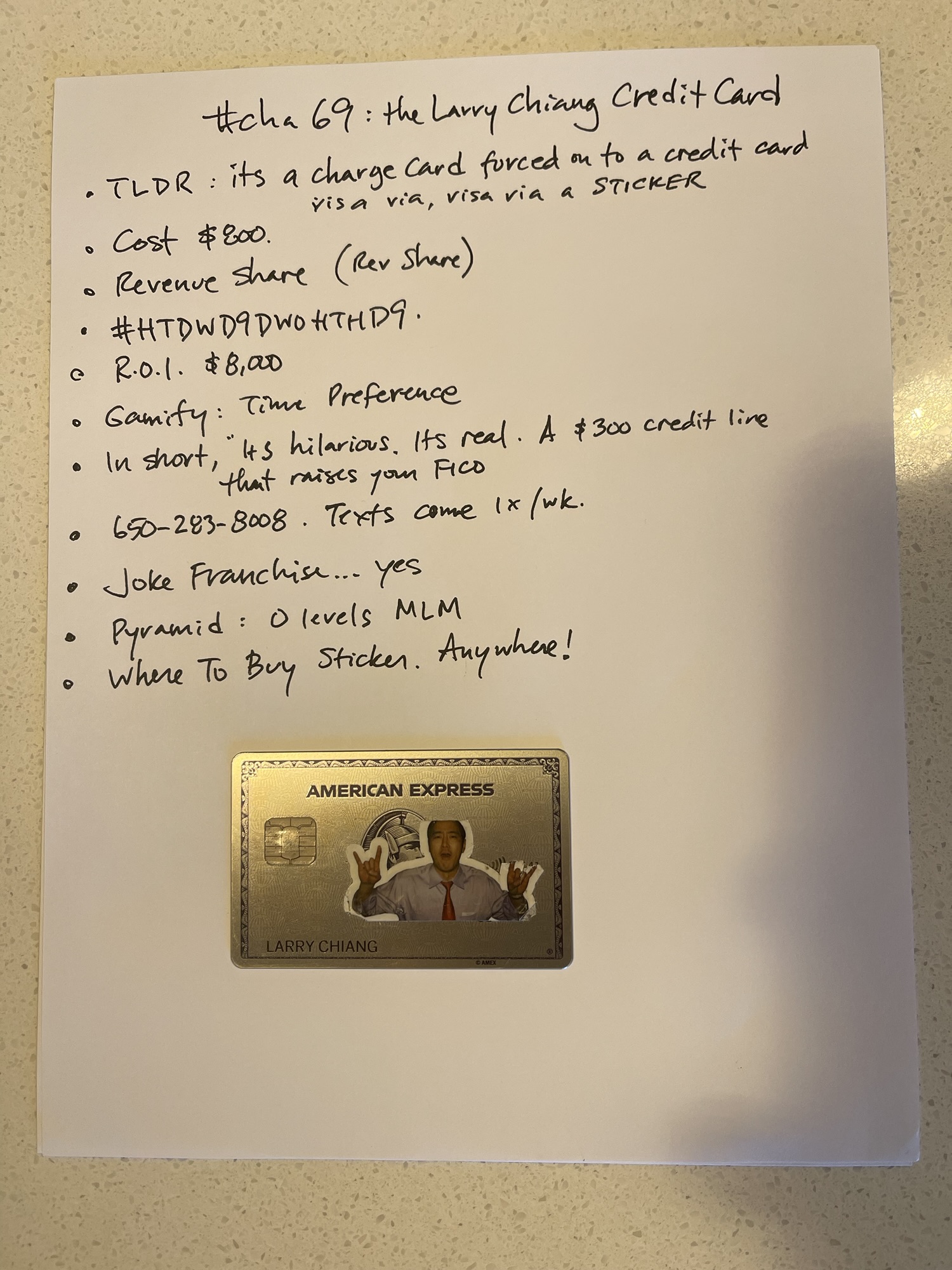
 Duck9 is a credit score prep program that is like a Kaplan or Princeton Review test preparation service. We don't teach beating the SAT, but we do get you to a higher credit FICO score using secret methods that have gotten us on TV, Congress and newspaper articles. Say hi or check out some of our free resources before you pay for a thing. You can also text the CEO: